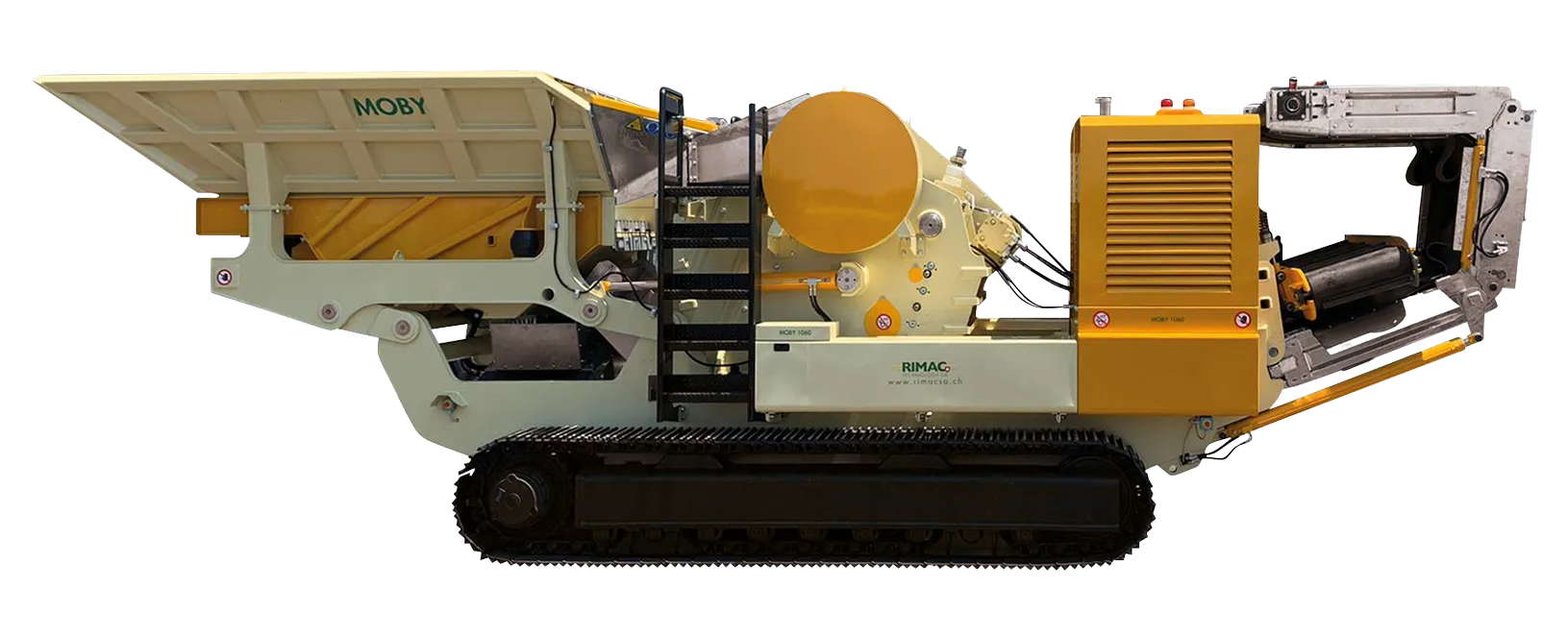
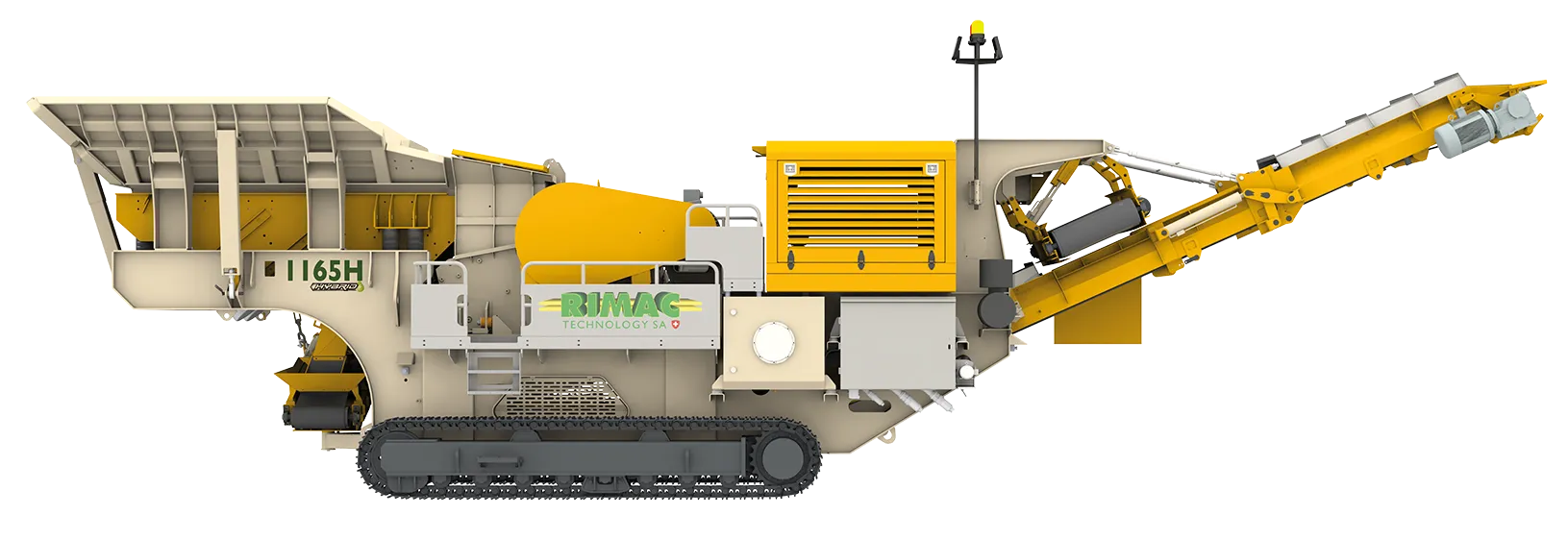
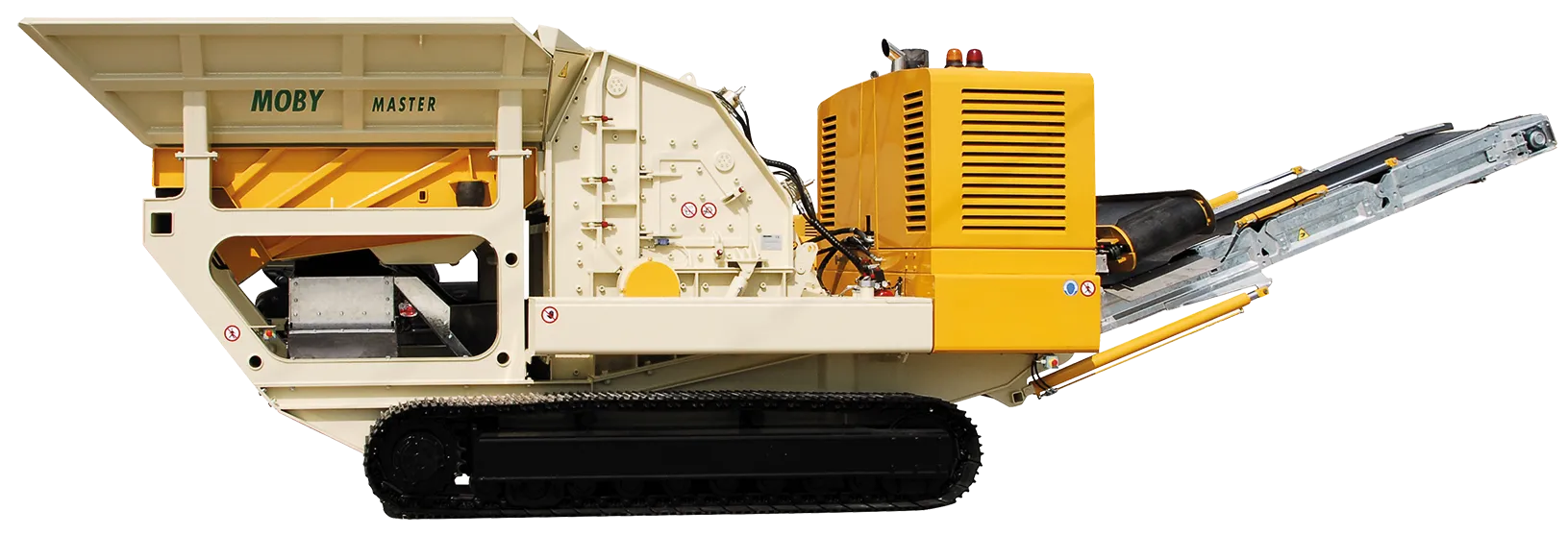
RIMAC jaw crushers are designed to exceed the primary crushing requirements of customers in the mining, quarrying, and recycling sectors.
The plants are divided into TRANSFORMER models with diesel/hydraulic or Hybrid power.
Key advantages of the TRANSFORMER series include the MULTIFUNCTIONALITY of the crushing unit, which allows for the replacement of the jaw crusher with other RIMAC systems (fixed hammer mill, free hammer mill, granulator) using a quick-coupling system; and INTERCHANGEABILITY, which allows for the rapid replacement of most components in the event of a failure (engine, crawler track, electrical system, etc.) to reduce machine downtime.
Hybrid series plants can be operated via the integrated generator control unit or connected to an external power source.
They are among the most widely used machines because they are simple, relatively inexpensive to build, and long-lasting.
They perform crushing by compressing material between two “jaws”—two toothed or smooth plates made of a special steel alloy. One is fixed, coinciding with the inner surface of the machine's housing wall, while the other, the movable jaw, moves toward and away from the first, causing the disintegration of the aggregates placed between the two plates.
Feeding occurs from the top; the shape and convergence of the jaws facilitate the downward movement of the material, directing it toward areas where the distance between the plates gradually decreases.
This achieves progressive crushing, with a final output whose maximum size is governed by the distance between the lower walls of the plates themselves. This distance is hydraulically adjustable, greatly enhancing the machine's versatility.
These crushers are intended for primary or secondary crushing. The resulting materials are angular, meaning they have edges suitable for the formation of road sub-bases and embankments, backfilling, drainage layers, etc.
RIMAC hammer crushers are designed to exceed the primary crushing requirements of customers in the mining, quarrying, and recycling sectors.
The plants are divided into TRANSFORMER models with diesel/hydraulic or Hybrid power.
The advantages of the TRANSFORMER series include the MULTIFUNCTIONALITY of the crushing unit, which allows for the replacement of the jaw crusher with other RIMAC systems (fixed hammer mill, free-swinging hammer mill, granulator) using a quick-coupling system; and INTERCHANGEABILITY, which allows for the rapid replacement of most components in the event of a failure (engine, crawler track, electrical system, etc.) to reduce machine downtime.
Hybrid series plants can be operated via the integrated generator control unit or connected to an external power source.
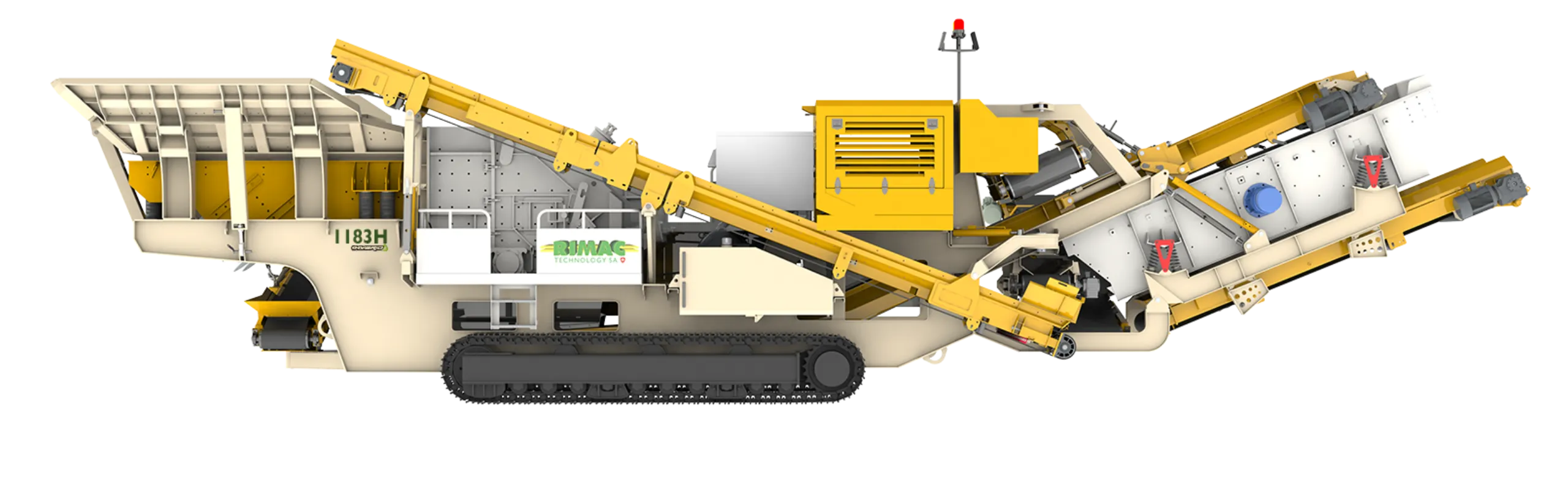
In these machines, crushing occurs through the impact of individual elements, which are violently hurled against the internal walls by a high-speed rotor (400-1500 rpm).
A significant portion of the disintegration also occurs due to collisions between the aggregates themselves.
Adjustment is performed by balancing the rotor's rotation speed and the distance between the internal walls. Impact mills produce polyhedral materials suitable for the production of concrete or bituminous mixtures, as well as for the formation of road sub-bases, embankments, backfilling, and drainage layers.
They are divided into:
· Fixed hammer mills: The feed opening is protected by a chain curtain that only allows entry. As the material moves along the chute, it reaches the crushing chamber, where it encounters the rotor's impact bars (the hammers). The material is then projected outward and collides with impact walls lined with interchangeable wear plates or with other incoming material. These crushers are generally intended for primary or secondary crushing.
· Free-swinging hammer mills: These are similar to fixed hammer mills, consisting of a rotor that projects fed material against the walls, causing it to break apart. They feature a steel housing enclosing the rotor with oscillating (free) hammers, an impact housing against which the material struck by the hammers collides, and a grid where the material is further crushed until it passes through the holes. Anything not reduced enough to pass through the bottom grid is picked up by the hammers and set back into motion. These crushers are generally intended for primary or secondary crushing.
Since crushing with crushers only controls the maximum output size, the resulting material produced by a single crusher is unsorted—meaning it is not separated into precise particle size classes. To obtain material sorted by size, screening is necessary.
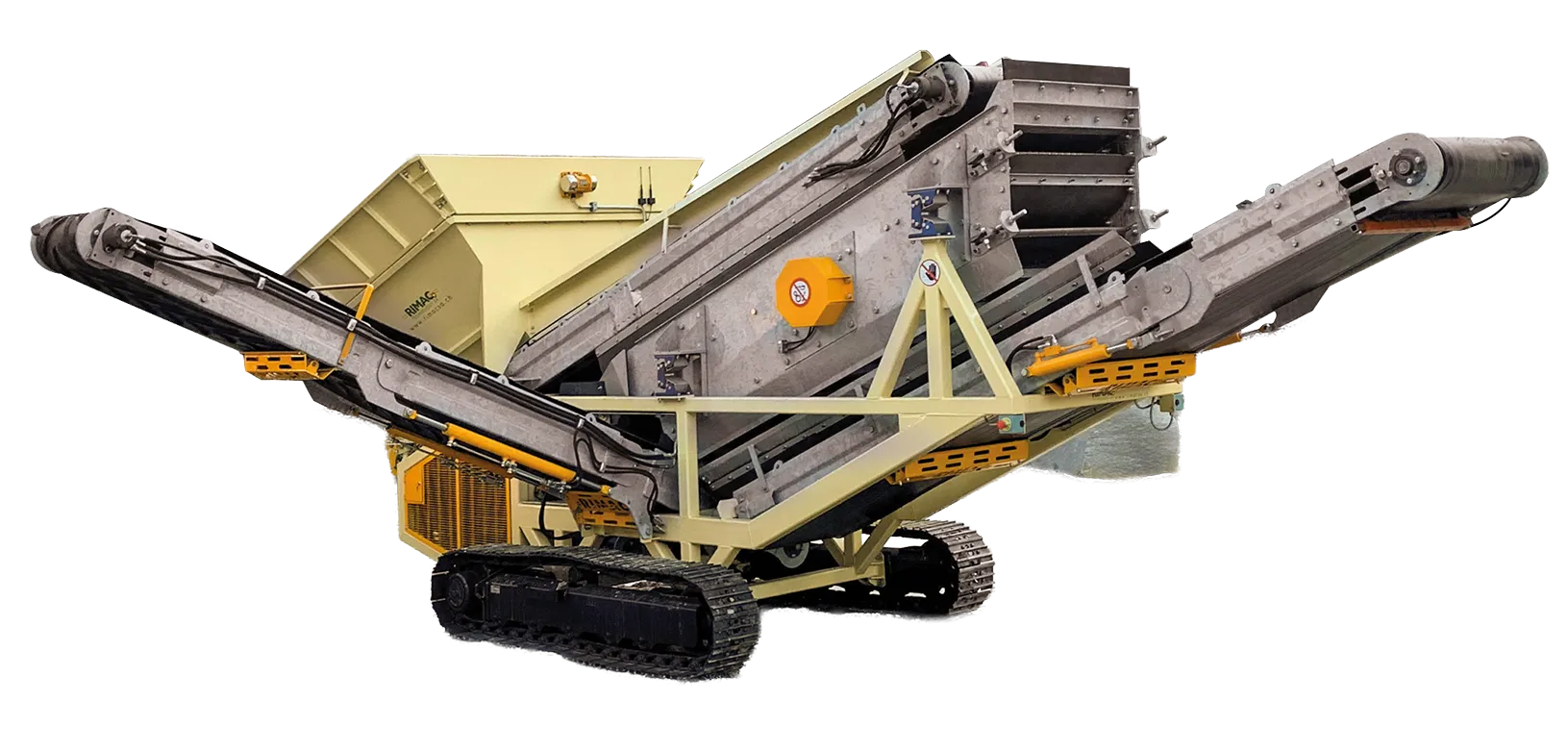
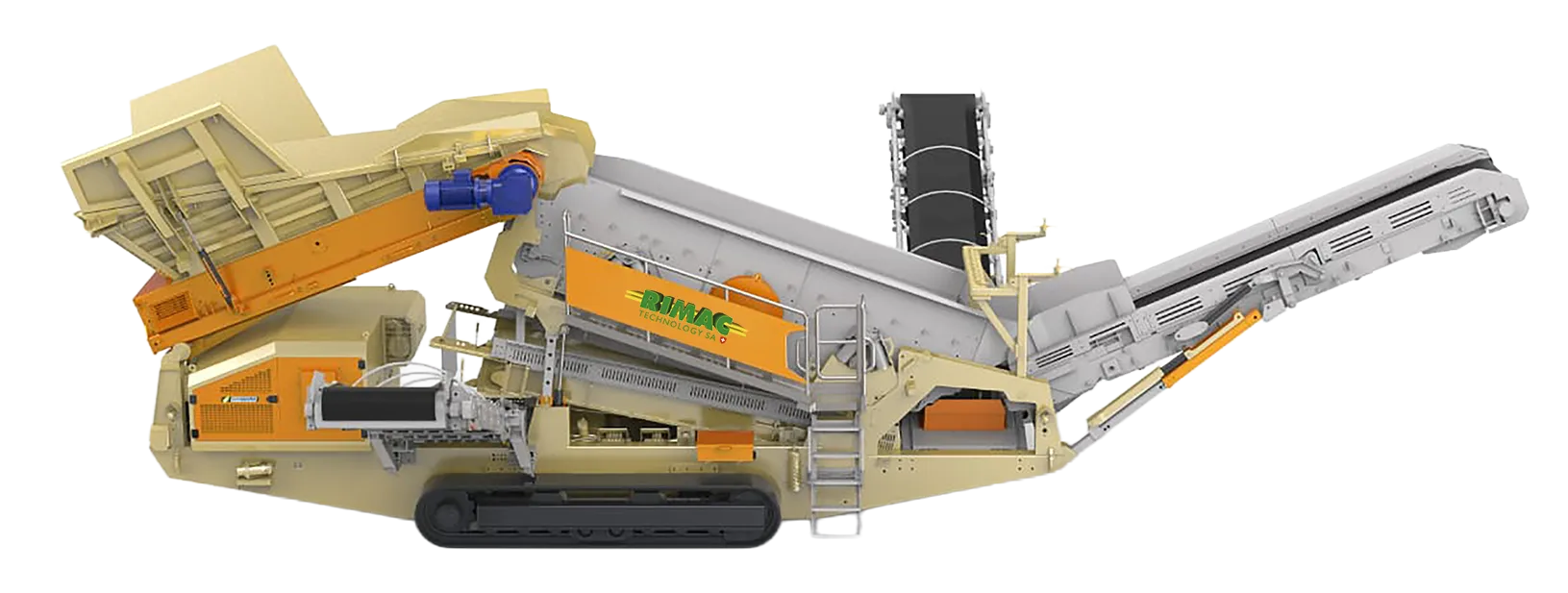
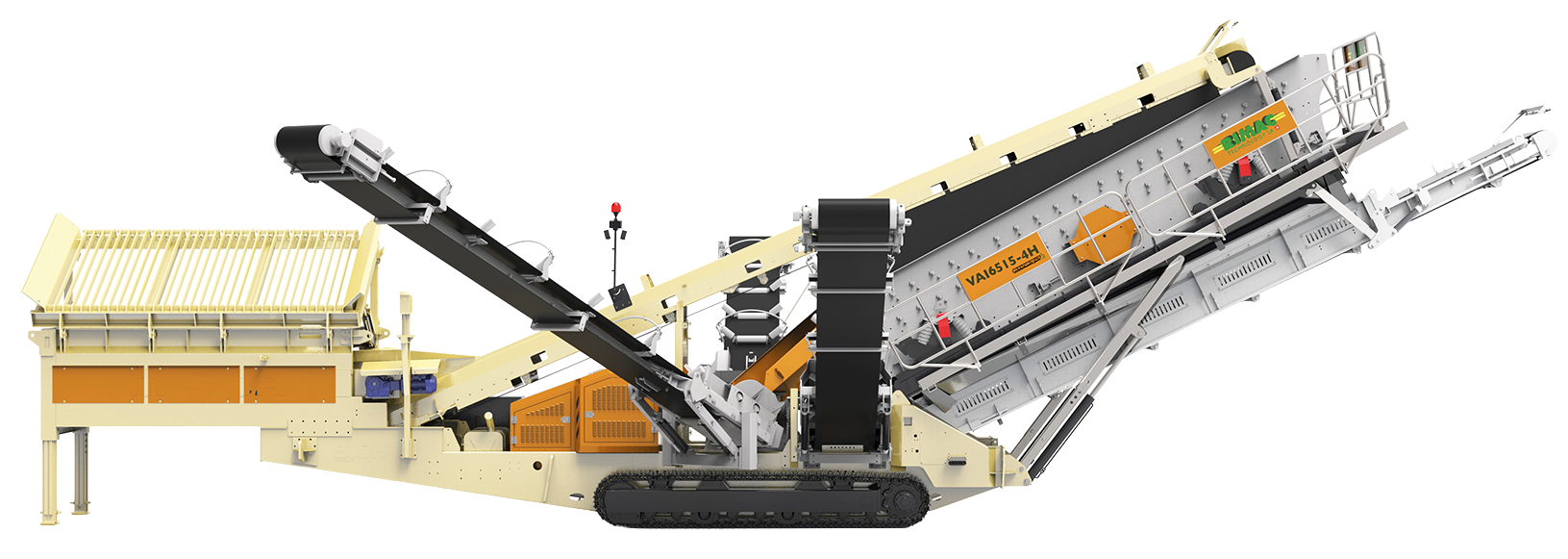
RIMAC screens and scalpers are designed to exceed customers' primary crushing requirements in the mining, quarrying, and recycling sectors.
These machines are among the most advanced and reliable on the market and are highly productive across a variety of applications.
The plants are divided into diesel/hydraulic or Hybrid models. The latter can be operated via the integrated generator control unit or connected to an external power source. Both power options provide operators with significant power as well as cost savings on maintenance and repairs compared to hydraulically or diesel-powered plants.
Screening is the process of separating aggregate materials into different particle sizes based on the dimensions of the installed meshes.
In an aggregate crushing plant, screening is performed using a screen, a device consisting of one or more stacked perforated plates—those with larger holes at the top and smaller holes at the bottom. These are placed on a frame and vibrated to facilitate material movement. The vibrations are generated by an eccentric mass shaft, typically operating at a frequency of 500-1500 cycles/hour, which allows aggregate materials to be separated based on their size.
RIMAC screens are divided into:
· Scalping screens designed for primary screening. These machines feature a screening deck consisting of a series of grizzly bars arranged in a cascade or perforated plates, depending on requirements. They are ideal for processing materials with a size of 0-500 mm.
· Refining screens designed for secondary and tertiary screening. These machines feature a screening deck made of perforated mesh arranged on an inclined plane. They are ideal for processing materials with a size of 0-130 mm.
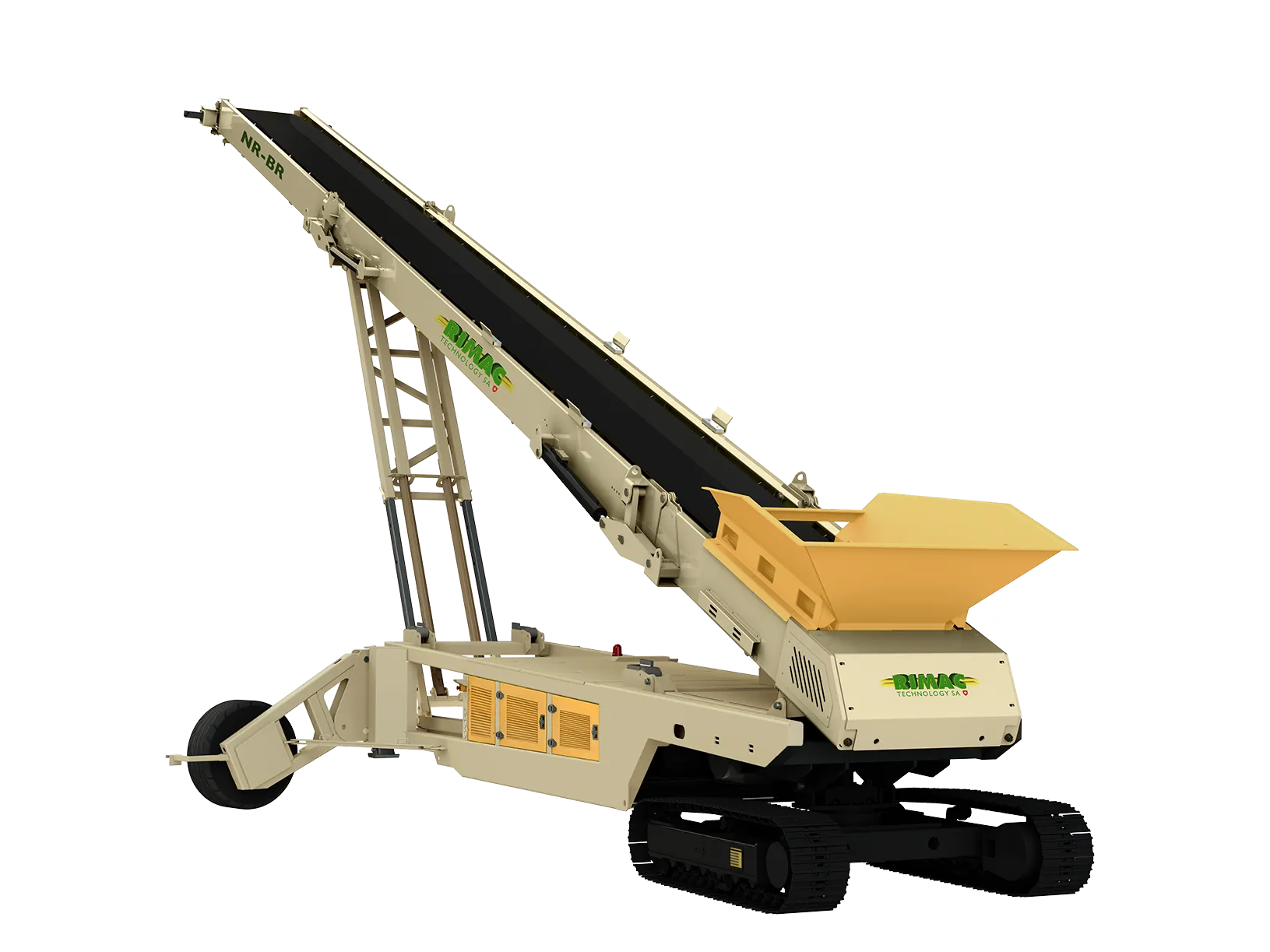
The conveyor belt is a highly powerful bulk storage management device, widely used in large mines, ports, sand and gravel aggregate sites, cement plants, and more. Designed to operate in the toughest environments, the conveyor ensures that screens and crushers run at their maximum capacity.
Our radial stackers set the industry standard, delivering best-in-class performance whatever the challenge.
Key advantages:
· A 75% saving compared to the costs of a wheel loader, with no need for an operator;
· Maximum mobility on tracks
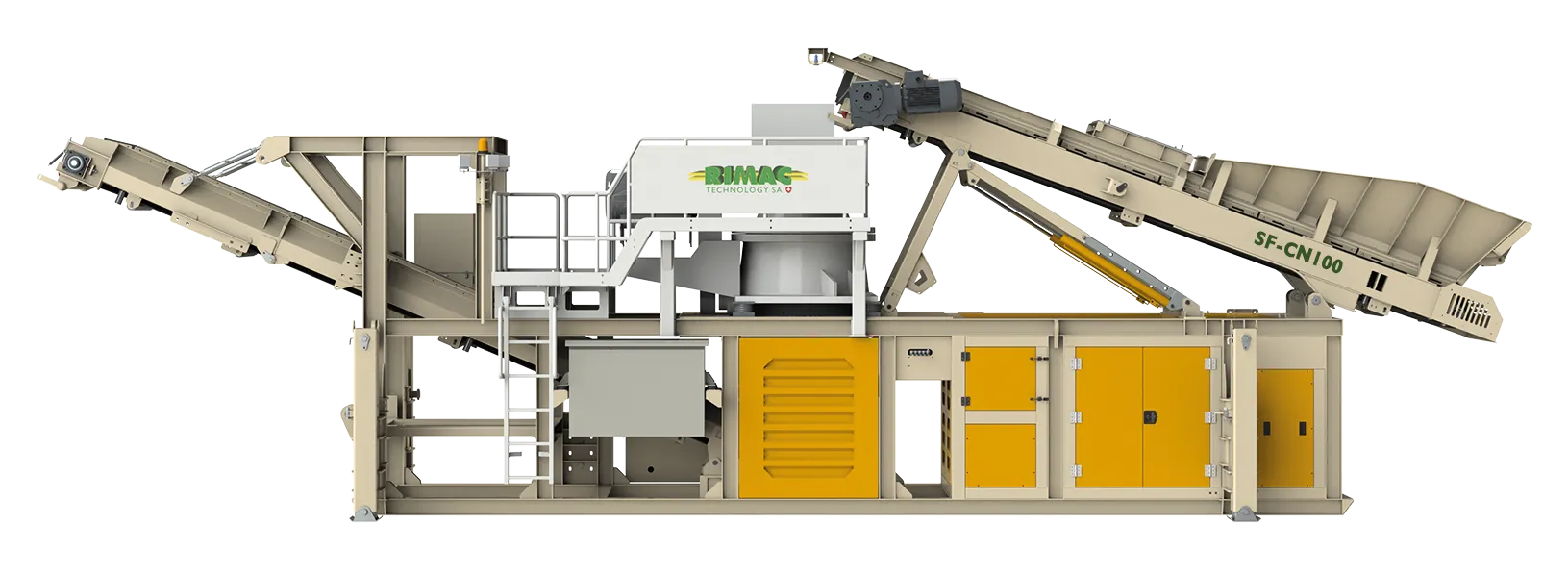
The SF series plants are specialized crushing machines suitable for sand production or for reducing material into microscopic fractions.
They can be equipped with diesel/hydraulic or Hybrid power.
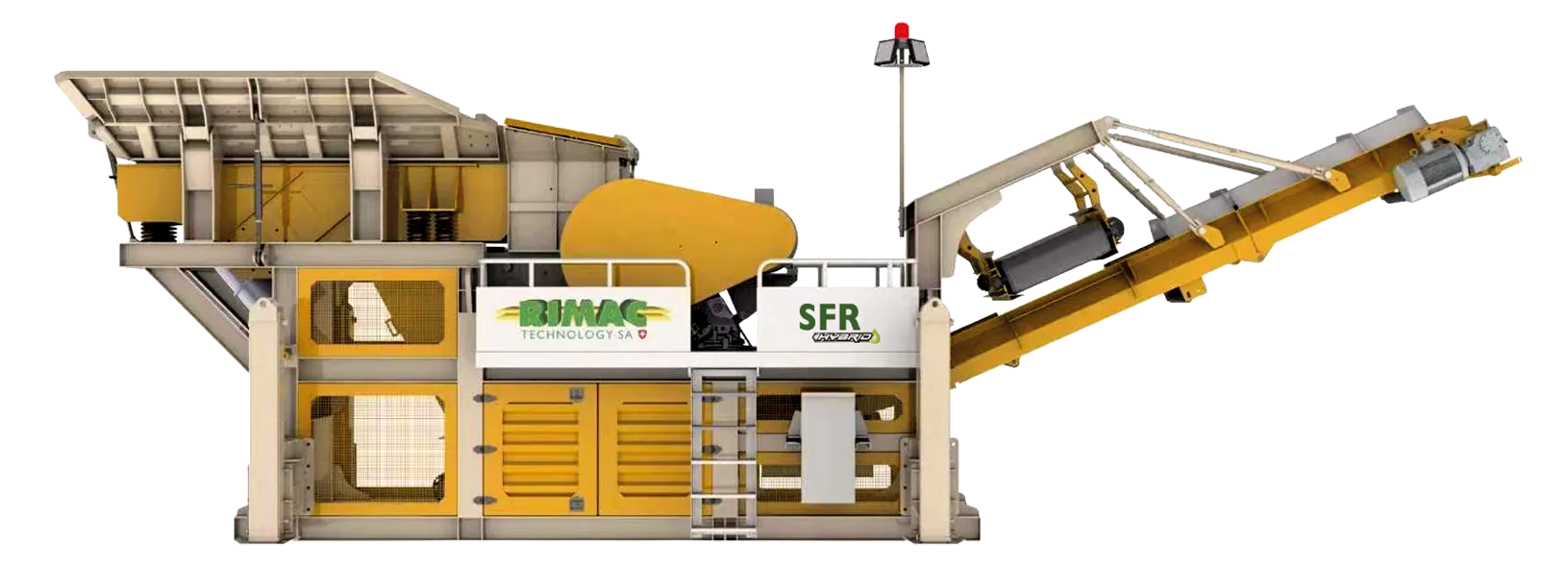
The SFR series jaw crushers are designed to exceed the primary crushing requirements of customers in the mining, quarrying, and recycling sectors.
They can be equipped with diesel/hydraulic or Hybrid power.
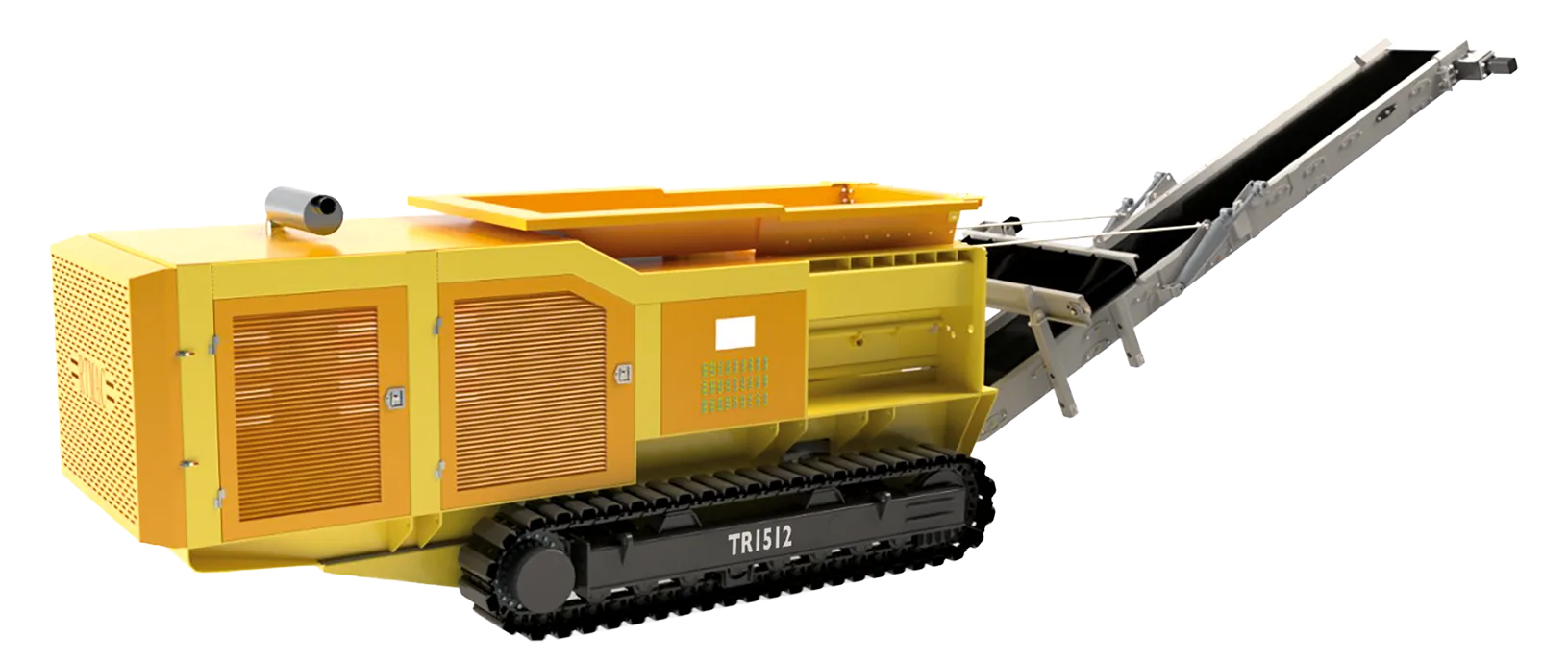
The mobile twin-shaft hydraulic shredder in the TR series is compact, flexible, and robust, offering an excellent price-quality ratio.
Equipped with an advanced automatic control system, it can shred various materials, including construction waste, household waste, rubber, and plastic.
Available in the stationary TRF version with electric operation
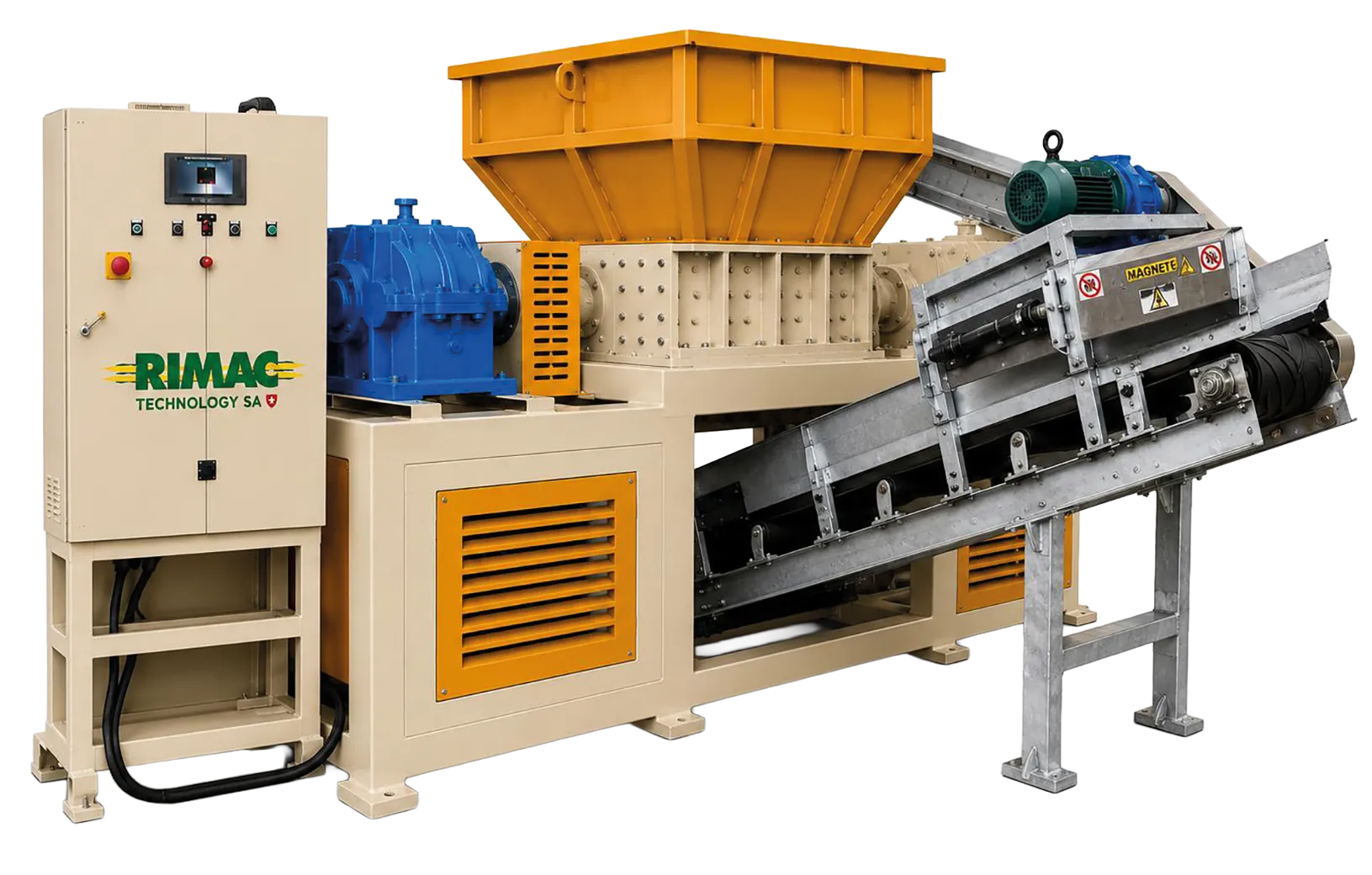
The mobile twin-shaft hydraulic shredder is a compact, flexible, and robust machine offering the best price-performance ratio in the industry.
The shredder features an advanced automatic control system and can process construction waste, household waste, rubber, plastic, and other soft materials.
Thanks to its compact transport dimensions, the plant can be loaded into shipping containers without dismantling the walls. Additionally, it does not exceed the maximum loading height for trucks.
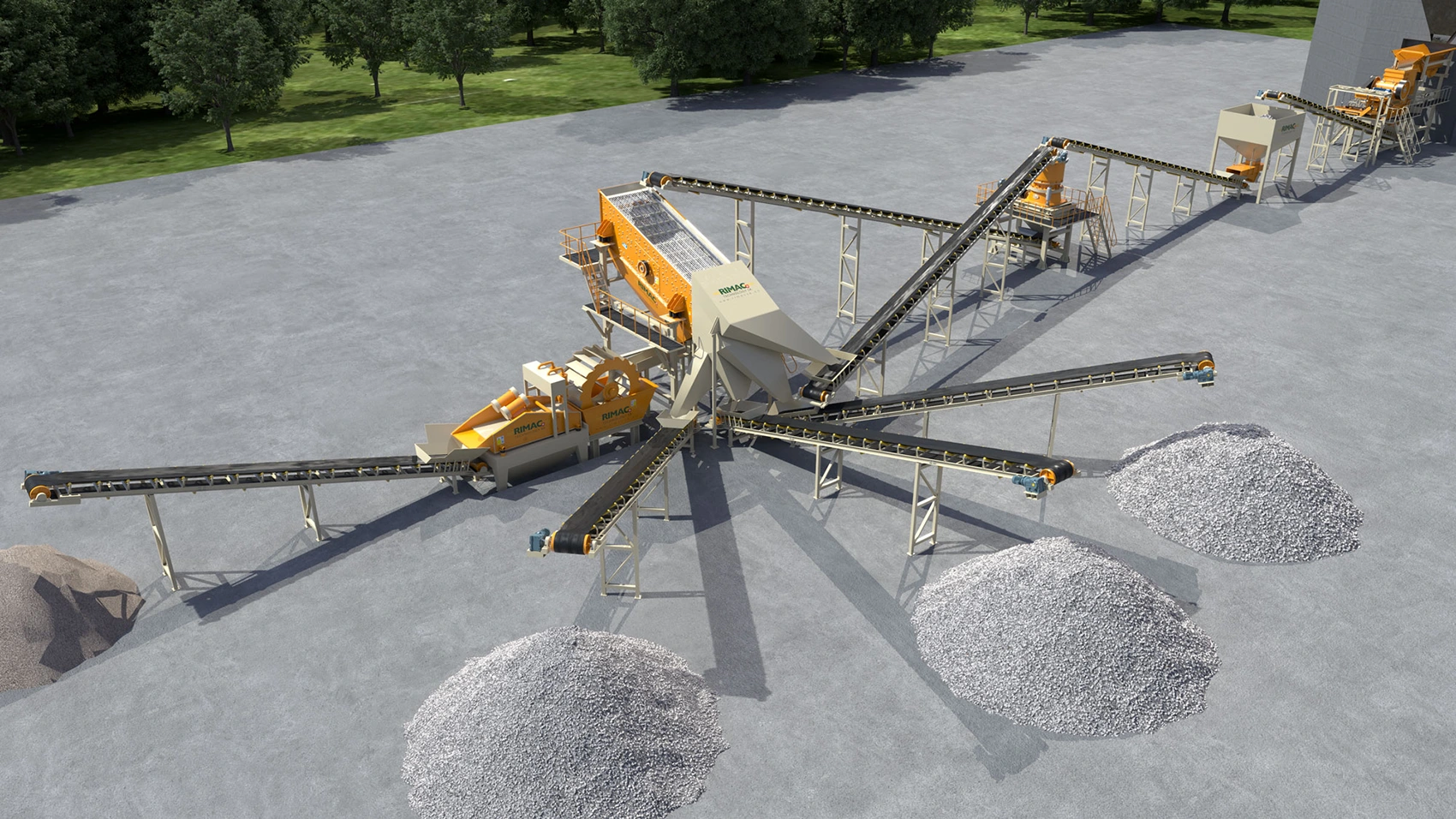
The RIMAC FX series of modular mobile plants offers a complete solution for crushing, screening, and washing aggregates. The modular steel structures are manufactured entirely in-house and require only minimal on-site foundations.
The modular system, primarily assembled using bolts, facilitates on-site assembly and significantly reduces installation time. Furthermore, the structure is designed to be easily loaded into containers, optimizing transport and reducing logistics costs.
RIMAC specializes in the design and manufacture of filtration, washing, and water treatment solutions, as well as specialized applications for washing and sorting aggregates and sand.
Our mission is to provide innovative, high-quality technologies that improve OPERATIONAL EFFICIENCY and promote ENVIRONMENTAL SUSTAINABILITY.
We offer a COMPREHENSIVE SUPPORT service, from initial consultation to installation and maintenance, ensuring our systems always perform at their best. Our products are used in various industrial sectors: in the MINING INDUSTRY, improving processes and reducing environmental impact; in AGGREGATE PROCESSING, including construction and demolition waste and land remediation; and in the STONE SECTOR, with water treatment systems for marble and granite.
Our plants are FULLY CUSTOMIZABLE to meet the specific needs of each client.